Garden Growing Wild
Published 2026-09-28
Listen
Also published on Daily Kos.
“Give me spots on my apples, but leave me the birds and the bees.”
— Joni Mitchell, “Big Yellow Taxi”
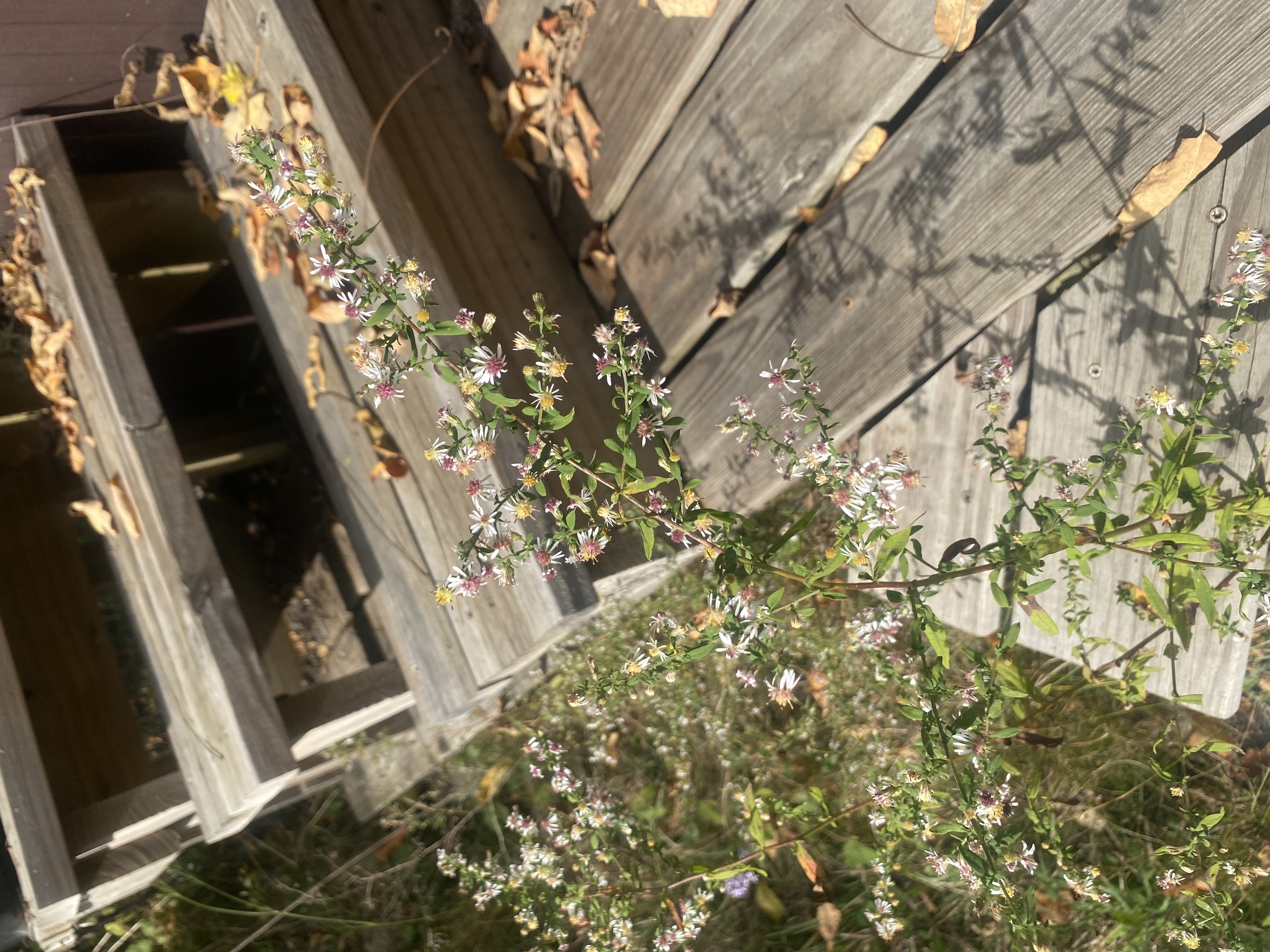
There is a flowering plant growing beside our steps.
Someone had told me that it was an invasive species, although I had never verified that. Mostly I thought of it as a weed. It had volunteered in an inconvenient place, and ordinarily that would have been reason enough to pull it.
But I left it.
I had noticed that bees visited its small white flowers, and it seemed wrong to remove something that provided them with food merely because it had chosen a place where I would not have planted it.
One afternoon in late September, I stopped to watch a bumblebee working among the flowers. It paid no attention to me. It moved methodically from one flower to another, gathering nectar and pollen, wholly occupied with whatever constitutes the immediate world of a bumblebee.
Watching it made me wonder whether the bee had any awareness of what else it was doing.
Of course, that is an anthropomorphic question. The bee was looking for food. I have no reason to suppose it understood that pollen clinging to its body would travel with it to another flower, or that by carrying the pollen it participated in the plant’s reproduction and genetic diversity.
But the bee didn’t have to understand.
The flower offered something the bee needed. The bee, pursuing its own needs, provided something the flower needed. Through evolution, each species had arrived at a relationship beneficial to both.
There is a word for this: mutualism.
It is tempting to describe mutualism as cooperation, but that makes it sound more intentional than it is. The interests of the two participants aren’t even identical. Bees actively collect pollen as food. They groom it from their bodies and pack it for transport. From the plant’s perspective, however, pollen collected by the bee is pollen that will not necessarily reach another flower. Some flowering plants have evolved ways of depositing pollen on parts of a pollinator’s body that it cannot easily groom.
The bee wants the pollen.
The flower wants the bee to leave with some of it.
Neither needs to understand the arrangement.
Evolution does.
Or rather, evolution has no understanding either. It simply preserves, generation after generation, relationships that work.
That thought led me to another relationship I remembered from years ago: the dodo and the so-called dodo tree of Mauritius.
The story I remembered was that the tree produced a fruit whose seed had to pass through the digestive system of a dodo before it could germinate. When the dodo became extinct, the tree continued producing its peculiar fruit, but could no longer reproduce successfully. Eventually, I had read, the tree would follow the dodo into extinction.
It is a wonderful story.
It also turns out to be too neat.
The tree is the tambalacoque. Later research challenged the idea that its seeds depended exclusively upon passage through a dodo. Other animals may have dispersed them as well. The famous story overstated the absolute dependence between these two species.
But the ecological principle behind the story remains important.
Plants can depend upon animals not only for pollination but for dispersing their seeds. An animal eats a fruit, travels somewhere else, and deposits the seed. Remove the animal and the tree may continue to flower and fruit. Mature trees may continue standing for decades or even centuries. To a human observer, nothing immediately appears to have changed.
But a relationship has disappeared.
And that may be the more important way of thinking about biodiversity.
We tend to think of biodiversity as an inventory. There are so many species of plants, so many insects, so many birds, so many mammals. Lose one, and the inventory becomes shorter.
An ecosystem isn’t an inventory.
It is a network of relationships.
An insect pollinates a flower. An animal eats a fruit. An animal carries a seed somewhere it could never have reached by itself. Fungi associate with the roots of plants. Predators limit populations of other animals. Organisms die and decomposers return their constituent materials to the living system.
Some of those relationships are redundant. Several species may pollinate the same flower or disperse the same seed. That redundancy gives an ecosystem resilience.
Others may be frighteningly specific.
Evolution can produce exquisite specialization, but specialization can also create fragility. A relationship refined over thousands or millions of generations can disappear when one participant disappears. The remaining organism may still be there, still flowering or producing fruit, while the ecological system that made its reproduction possible has already begun to vanish.
We do not know all of these relationships.
That seems to me one of the strongest arguments for biodiversity, and also one of the strongest arguments for humility when we alter the natural world. We are participants in ecological networks whose architecture we only partly understand.
Which brings me back to the plant beside the steps.
After watching the bumblebee, I photographed it. I wanted to know what this invasive weed actually was.
It probably wasn’t invasive at all.
The plant appears to be one of our native asters, quite possibly calico aster (Symphyotrichum lateriflorum), although I would need a closer botanical examination to identify the species with confidence. Several similar asters are native here in Maine. Asters flowering in September can provide late-season food for pollinators such as the bumblebee I had been watching.
I had nearly everything backward.
The plant wasn’t necessarily an invader. The fact that I hadn’t planted it didn’t mean it didn’t belong there. And its inconvenient location beside the steps wasn’t evidence that it was in the wrong place.
It was in the wrong place for me.
For the bumblebee, it was exactly where food was.
Christopher Alexander, Sara Ishikawa, and Murray Silverstein describe something very much like this in A Pattern Language. One of my favorite patterns is number 172, Garden Growing Wild.
The pattern does not call for abandoning gardens. A garden still has paths and places for people. We still make choices about what grows and where. But Garden Growing Wild asks us to relinquish the assumption that we must completely control every part of a garden. Plants can find places for themselves. Natural processes can participate in the design.
I have always loved that idea.
Now I think the bumblebee has given me another reason for loving it.
A garden growing wild leaves room for relationships we did not design.
That doesn’t mean we should leave every volunteer plant where it appears, or that we should allow invasive plants to displace native ones. There are good reasons to intervene in a garden.
There are stairs that must remain stairs.
But perhaps intervention should sometimes begin with observation.
What is growing here?
What visits it?
What feeds upon it?
What depends upon it?
And, perhaps most importantly:
What don’t I know?
More than fifty years ago, Joni Mitchell put the bargain memorably: accept some spots on the apples and leave the birds and the bees.
There is an entire philosophy of gardening—and perhaps something larger—in that exchange.
The spotless apple represents one conception of a successful garden: orderly, controlled, productive, perfected for human purposes. But achieving that perfection can have costs that aren’t visible on the surface of the apple. The spots may be evidence that the apple exists within a living system rather than outside one.
My little aster certainly isn’t orderly. It chose its own location. It intrudes slightly upon a space we made for ourselves. By conventional standards of gardening, pulling it would have been perfectly reasonable.
Instead, for no particularly sophisticated reason, I left it alone.
Then a bumblebee came.
I watched it harvesting among the flowers, apparently indifferent to the enormous human standing nearby. Because I had not pulled the plant, I was able to watch a relationship that neither I nor the bee had designed: flower feeding bee, bee pollinating flower, each participating in something larger than itself.
The bee didn’t know what it was doing for the flower.
I didn’t know what the flower was doing there.
Sometimes that is reason enough not to pull the weed.